An early start to the day. We made our way from our hostel to the Sabana Train Station, fully documented up. Passports - check, train tickets - check. What I neglected to bring was the address of the hostel, or one of their cards, but more on that later.
Initially, we wondered if it was necessary to purchase our tickets in advance but when we departed the second stop with nary a seat available, we congratulated ourselves on our forethought. This is actually something I'm a bit OCD about, as I HATE wasting time when we're off the boat. So much to see, so little time (and money). Lots of people say that they LOVE to be spontaneous when they travel....those people either have a lot of time, a lot of money, or no sense. Upon arrival in Bogota, even after our 9 hour overnight bus ride from San Agustin, I made the executive decision to head straight to the station to get our tickets to visit the Salt Cathedral the next day.
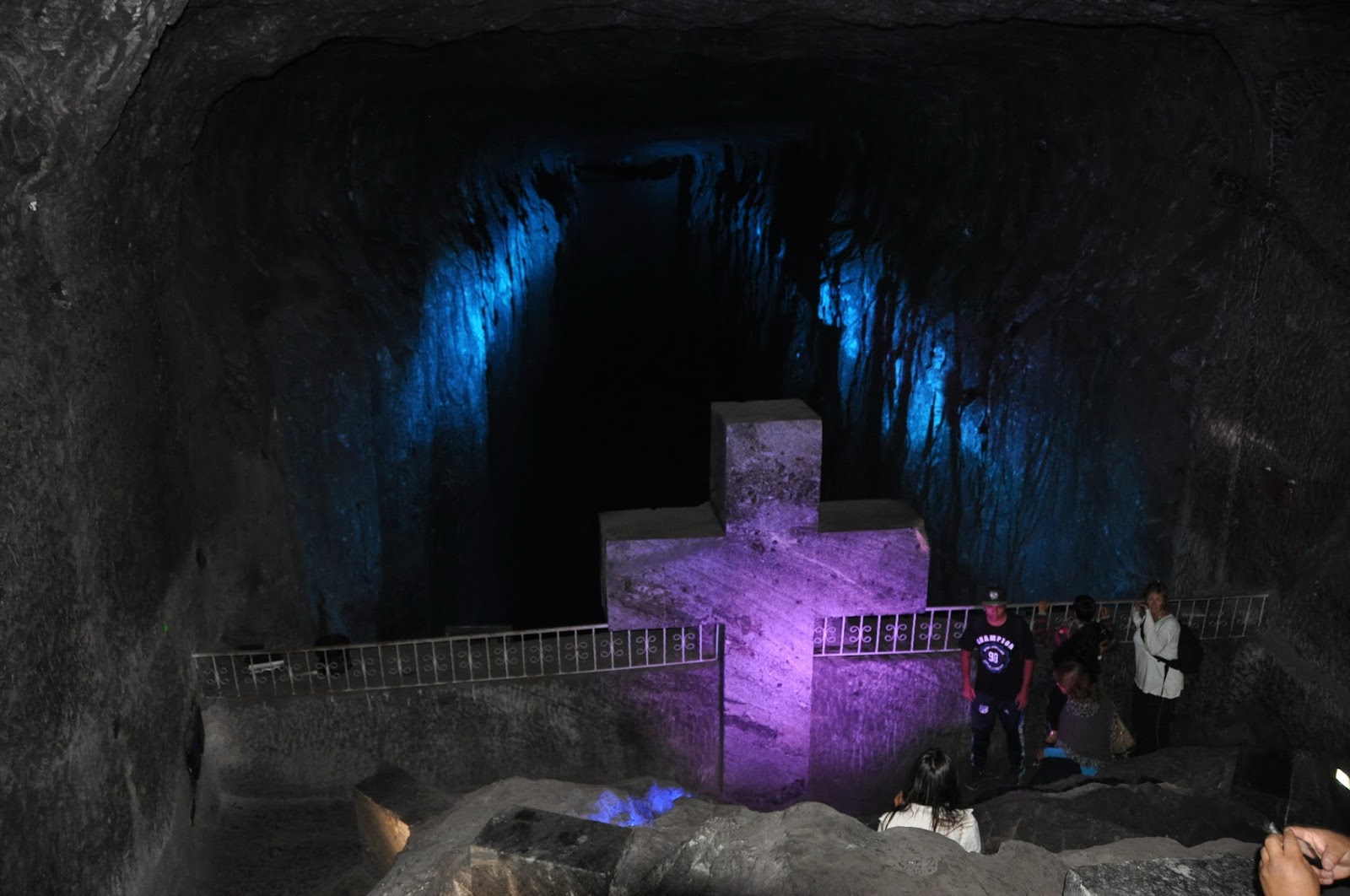
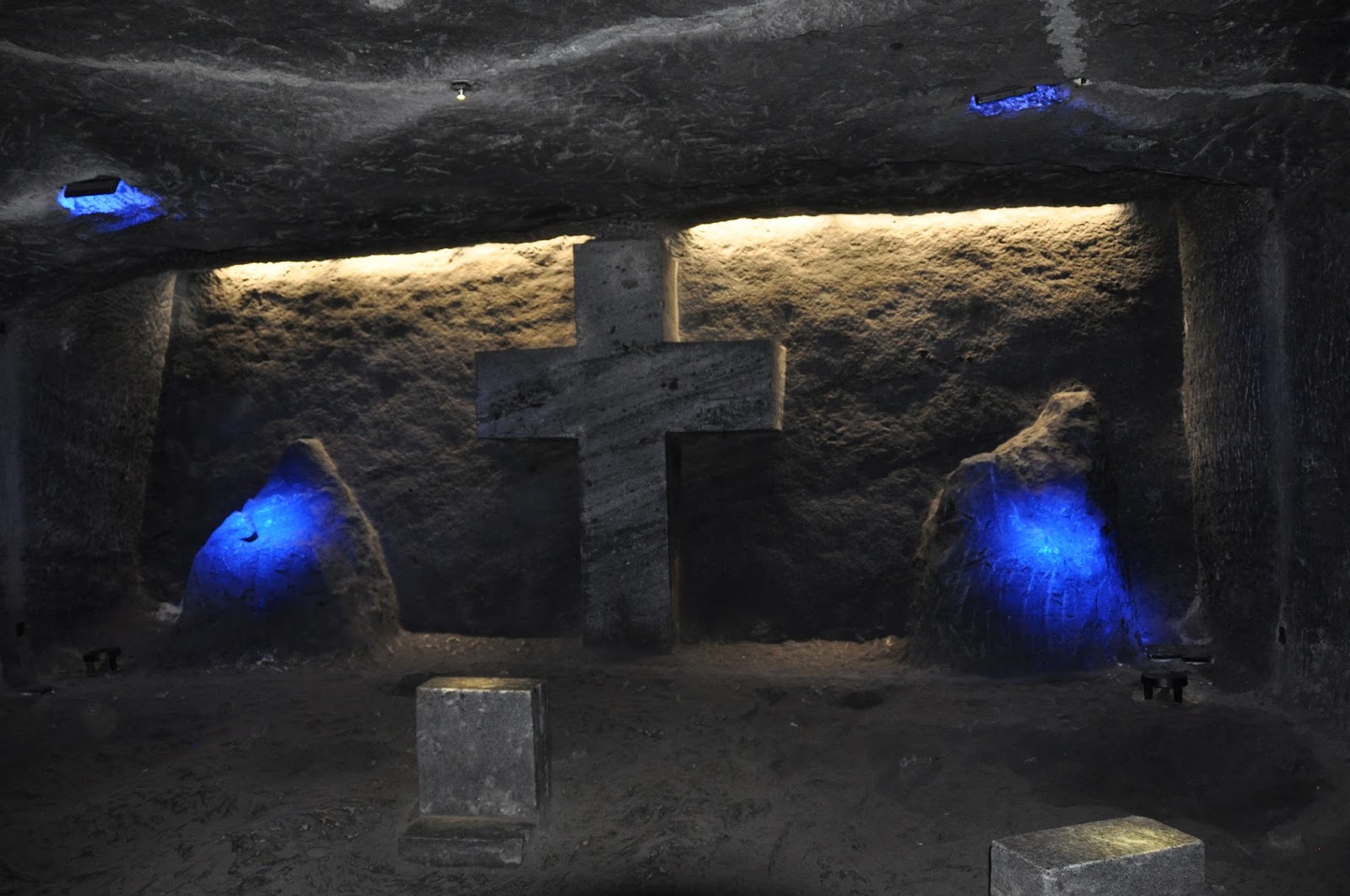
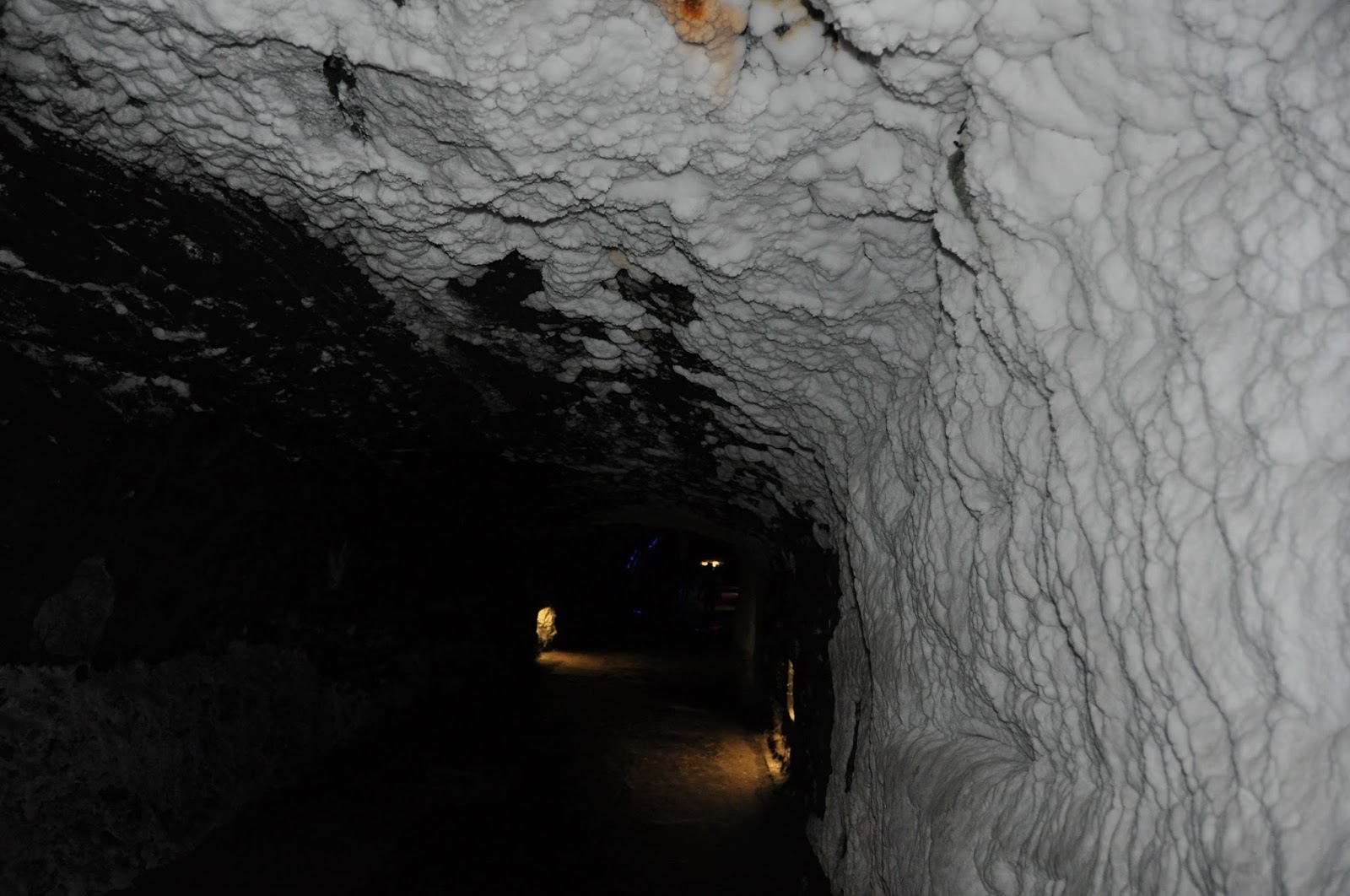
We rattled our way towards the community of Zipaquira, a pueblo that has obviously enjoyed the fruits of having a major attraction in its midst. Beautiful brickwork lined the sidewalks and although it was a Saturday there wasn't a bit of trash on the roads. While were were in the train heading to our destination, we purchased entrance tickets for the Cathedral and the transport to/from the train. Suffice it to say we were blown away with the immense scale of the underground crosses and the Cathedral itself. Twelve different crosses, all carved/mined in a different way, representing the steps towards the resurrection of Christ. After seeing the crosses, you come to a vast sanctuary. The last photo shows the scale of one of the columns. You don't have to be religious to truly appreciate this place, but....you have to visit it yourself to believe it. Unfortunately, I have no words to really describe it, and our photos do not do it justice. For more info, see http://en.wikipedia.org/wiki/Salt_Cathedral_of_Zipaquira
After an entire day of being tourists, we are always tired and today was no exception. We had made it back to Bogota, except, we still had to figure out where we lived. The cabbie didn't know our particular hostel amongst the myriad of others in the historic center but I channeled my inner bloodhound and we drove right to it. I impressed even myself....
Saturday, August 31, 2013
Statues, sugarcane, and....bras? August 13-15, 2013
I belong to a Facebook group called Women Who Sail. While writing this blog post, I was switching
back and forth between my words here, and a thread on “customs”. As happens so many times, for some reason the
topic got switched to "bras"…..and so goes the conversational pattern of most
women. Funnily, but the subject of bras
was on my mind as I was recalling our journey from Popayan, Colombia to San
Agustin. I knew that our road was going
to be a bit rough. It said so in the
guidebook, and we had seen it in print in other places. We had even been told to expect an “interesting”
ride. We were mentally prepared, or so
it seemed.
Upon arrival at the bus terminal, our 9:30am departure was
still a go, but apparently there was also one in…..1 minute. We were hustled aboard, only to find that
pushing our departure one hour ahead, also meant that we got the last 2 seats on
the bus, and they weren’t the good ones.
Ron was the “lucky” one (as men usually are who have women with them
that don’t want to hear any whining) and got a seat in the middle in the
back. Granted, the seat cushion didn’t
seem to be attached to anything, and threatened at each turn to pitch him into
the lap of the little girl sitting on the floor in front of him. Me, well I got to cuddle the 7 boxes holding
all the tomato seedlings destined for…..somewhere. This doesn’t sound like an inconvenience, but
it sure is when they are stacked to the ceiling, and every 15 seconds, around
yet another curve at Indy Car Rally speeds, they threatened to decapitate
me. Although our year's traveling had
shown us a thing or two, this bus ride was supposed to take 7 hours. After 15 minutes, I turned to Ron and told
him I didn’t think I could do it for that long.
He only exclaimed, “hang in there.”
It was a
few hours into this trip that the notion of bras was uppermost in my mind. It was a two-bra kind of journey, and I knew
when we would disembark, my boobs would have migrated their way down to my lap, or perhaps puddled around my ankles.
San Agustin was our destination. A small village in the southwest portion of
Colombia, it boasted over 500 statues scattered throughout an area roughly 250 square miles, standing guard over ancient tribal
tombs. Not much is known about the
people who erected them, as they disappeared prior to the arrival of the
Spaniards. I won't bore you with all the photos we took, as I bet we have 2 or 3 of every one of them!!
| Somewhat reminiscent of an early-day Sponge Bob |
There were so many of them, that a day later, the joke was….”mmm,
another statue……mmm, great."
This is a good time to talk about the Colombians. Ron thinks I generalize, and maybe sometimes I do, but it's very interesting to meet with people from different countries. The better my spanish becomes, the more I can recognize the different sub-cultures, even amongst Latin Americans. THEY ARE NOT ALL ALIKE. Some recognizable attributes are:
Colombians are VERY gregarious. They like nothing better than to talk, alot, with alot of emotion.
Colombians want you to like their country. We were constantly asked if we did....and we were honest in saying that we loved it, and them. Agradable is the word.
Colombians are very happy, and busy. Actually, they are really HAPPY, and BUSY.
Colombians want to know about who we are and always want to know where we are from, how long we were in their country, and how long we were going to stay.
Colombians wanted to have their pictures taken with us. We always happily complied.
A day later, we embarked on a jeep tour of more statues, waterfalls, rivers, and most interesting, the way in which they process sugarcane, making the product panella. We munched our way around Colombia eating panella coated peanuts.
It was about this time that we started to hear rumblings
about an imminent nationwide strike, about to be called by the campesinos of
Colombia. But we were only 9 days into
our first inland trip in months! If you
learn nothing else when traveling, know that life will always change the best
laid plans.
Mercado Madness - August 9-11, 2013
If anyone is heading to northern Ecuador, the thing to do is
plan to be there for the Saturday market.
All the villages in the surrounding valleys converge on Otavalo,
bringing the usual, and immense, assortment of fruits and vegies, along with
the special handicrafts of the region.
While there were a few tourists
there, this market seemed to be more about the locals. We’ve visited the Ocatlan Friday mercado
outside of Oaxaca, Mexico, and the famous Saturday Chichicastanango mercado in
Guatemala, and yet we never get tired of seeing the vibrant community life
enacted before our eyes. The amount of
“stuff” on offer was staggering, from clothes to alpaca ponchos, and everything
in between. For us, this trip to the
market was about the food. By noon, we
were stuffed to the gills. Bunuelos,
paella, whole roast pig, every configuration of bread products, it was there and
in abundance!
Tomorrow we make a run for the Colombian border.
Friday, August 30, 2013
Gasping - August 8, 2013
All the guidebooks say to take it easy when you first arrive at a location with a significant altitude. "Take it easy, acclimatize, drink lots of water, avoid alcohol, don't exert yourself." Uh huh, yeah right, okay.
We were off to the teleferiQo, Quito's newly installed cable car. It felt like old home week as I stepped into the gondola made by Poma, although a lot warmer than I was used to, and carrying a lot less gear. It was bliss.
We were flouting conventional wisdom, and although we have been living at sea level for years, surely those acclimatization rules didn't apply to us, we told ourselves. We wanted to do "a bit" of walking and the trail to Pichincha (Quito's resident volcano, located at 4,784 m or 15,696 ft) seemed to be just the thing. (See Green arrow below, which was where we were going). After all, we had climbed Izalco in El Salvador, and Pacaya in Guatemala. We could bag another volcano! Turned out, we were insane.... 1 and 1/2 hours into it, and being passed by fit, young men looking like they'd be right at home on Mont Blanc, we happily took photos of "the hill we didn't climb in Quito" (Red arrow below, and the sentiments attached). But, I kept saying to Ron, the book said it was a three hour walk. "Just be sure to set out in the morning, before the clouds obscure the view." We set our sights on the first electrical power pylon and called it good.
Upon our descent, we saw the sign we had missed upon initially setting out, which called it a difficult, 5 hour trek, ONE
WAY. Hahahahahaha.....
Scattered around our hostel were posters and prints of strange looking men with expressions of anguish, soulful eyes, and evocative fingers. Learning that they were by Ecuador's "father of art", Oswaldo Guayasamin, we hauled our weary selves to the museum, workshop and Capilla of this most influential of artists. His personal story is amazing and his work, compelling. We vowed to return to purchase a few pieces to call our own.
I had many more sights to see on my Quito list but what we really wanted to see in front of us by this time was a cold beer or three. Despite it being "the dry season" in Ecuador, we found ourselves in the midst of a lightning and thunderstorm like what we had left behind in Panama. This time tho we were just afraid of getting wet, rather than getting hit. Things have definitely improved in the last few weeks.
We were off to the teleferiQo, Quito's newly installed cable car. It felt like old home week as I stepped into the gondola made by Poma, although a lot warmer than I was used to, and carrying a lot less gear. It was bliss.
We were flouting conventional wisdom, and although we have been living at sea level for years, surely those acclimatization rules didn't apply to us, we told ourselves. We wanted to do "a bit" of walking and the trail to Pichincha (Quito's resident volcano, located at 4,784 m or 15,696 ft) seemed to be just the thing. (See Green arrow below, which was where we were going). After all, we had climbed Izalco in El Salvador, and Pacaya in Guatemala. We could bag another volcano! Turned out, we were insane.... 1 and 1/2 hours into it, and being passed by fit, young men looking like they'd be right at home on Mont Blanc, we happily took photos of "the hill we didn't climb in Quito" (Red arrow below, and the sentiments attached). But, I kept saying to Ron, the book said it was a three hour walk. "Just be sure to set out in the morning, before the clouds obscure the view." We set our sights on the first electrical power pylon and called it good.
![]() |
| Green means, Go - Red means, WTF, STOP!!! |
| So naive first thing in the morning, see that thumbs up?! |
| Several hours later, cooked and DONE! |
| Not quite as perky as he used to be |
Scattered around our hostel were posters and prints of strange looking men with expressions of anguish, soulful eyes, and evocative fingers. Learning that they were by Ecuador's "father of art", Oswaldo Guayasamin, we hauled our weary selves to the museum, workshop and Capilla of this most influential of artists. His personal story is amazing and his work, compelling. We vowed to return to purchase a few pieces to call our own.
I had many more sights to see on my Quito list but what we really wanted to see in front of us by this time was a cold beer or three. Despite it being "the dry season" in Ecuador, we found ourselves in the midst of a lightning and thunderstorm like what we had left behind in Panama. This time tho we were just afraid of getting wet, rather than getting hit. Things have definitely improved in the last few weeks.
Questing in Quito - August 6-7, 2013
The first leg of our inland adventure took us to Quito. We had the option of paying $7.50 per person for the 8 hour bus trip from Bahia de Caraquez, but we splurged right off the bat and sprung for the "executive" bus at $10 each. An easy trip but always the question needs to be asked..."why does the air conditioning need to be set on Arctic?"
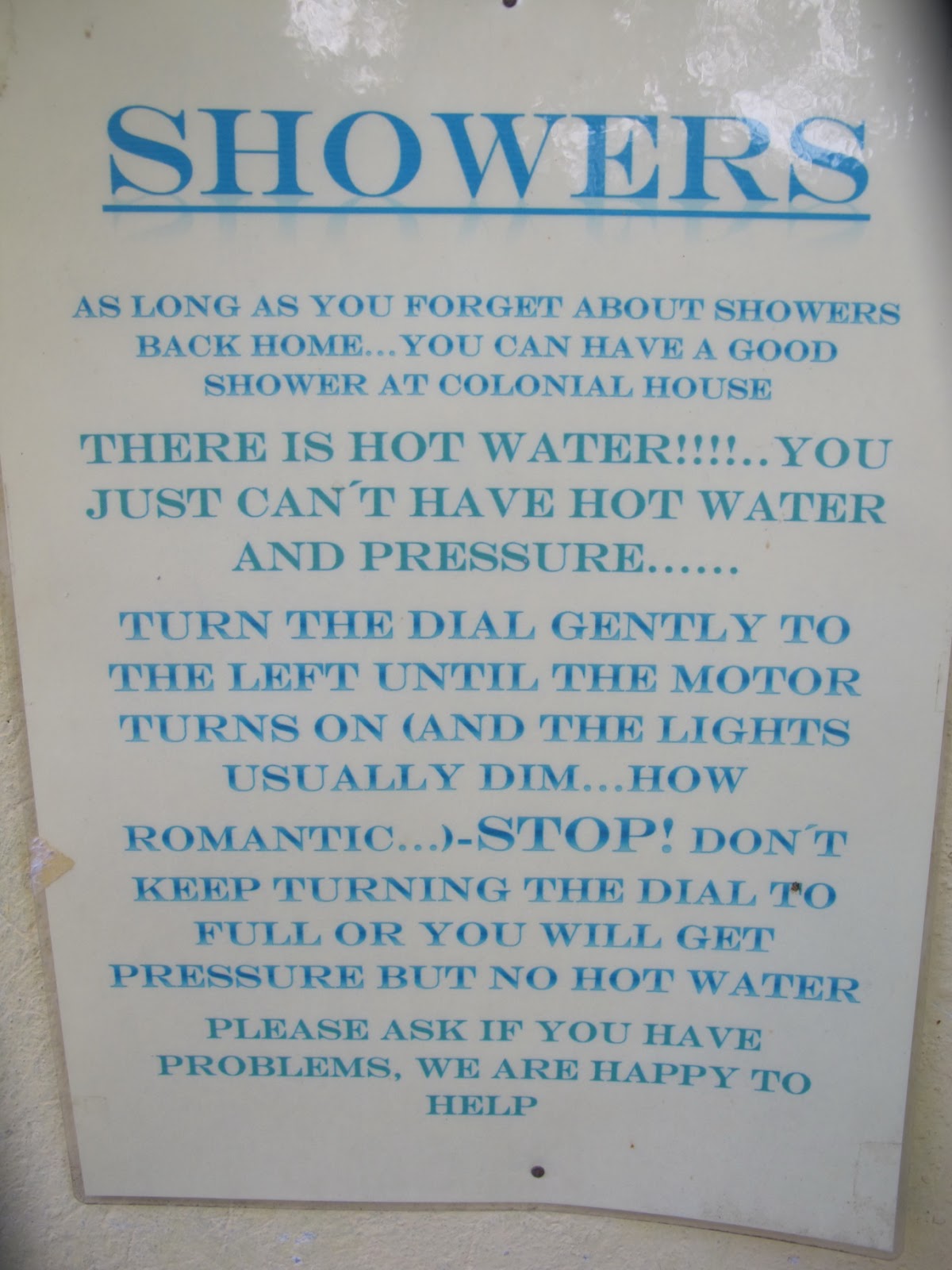
We settled into our hostel, after being turned away from our first choice - apparently no room at the inn. Colonial House was a funky maze of rooms and cubbies in a 200 year old building, complete with wi-fi, a cooler full of Pilsners, and a great back garden (check out the gym equipment). The cost....$10/person.
I had put together an itinerary that called for our first day of exploring to be The Day of Views. We first tried an assault on the hill holding up El Panecillo, the Virgin of Quito, and what was to be the Holiest View. We started up the steps but quickly turned around when a local woman passed us heading in the opposite direction. Shaking her finger at us and swiping it across her throat, we got the message (easily understood in any language) and opted for a taxi instead. The 360 degree view was worth the $4 cab ride.
Next was the Deadliest View, at the Basilica del Voto Nacional. Scrambling through the interior of the church's roof, we climbed up rickety steps to get to the top of the exterior roof and then higher to the belfry, and still higher to the uppermost tower.
Combined with Quito's 2800 meter altitude, surely this was the closest Ron and I had been to God in a loooonnnngggg time.
Ending our first day was The Strangest View, at the Monastery of Santa Catalina. Actual cloistered nuns, gruesome crucifixes, and the secreted bones of an assassinated Ecuadorian president, rounded out the day in a certain style. The trip to this bell tower was also pretty great.
Our first day drew to a close with an awesome pizza at The San Blas Cafe, within walking distance of our hostel and just around the corner from the Bellamonte Plaza de Toros (bullfights now suspended by the current, not deceased, president).
We ended up having every dinner at the San Blas. While we didn't visit the islands, we DID get great food.
Not a bad way to start our inland travels...
We settled into our hostel, after being turned away from our first choice - apparently no room at the inn. Colonial House was a funky maze of rooms and cubbies in a 200 year old building, complete with wi-fi, a cooler full of Pilsners, and a great back garden (check out the gym equipment). The cost....$10/person.
| Colonial House, Quito |
| The Gym, Quito-Way |
| Shower Instructions |
| El Panecillo - Virgin of Quito |
| El Jefe - Non-Virgin of Sundancer |
| El Basilico del Voto Nacional |
| Into the Bowels |
| My Bat-in-the-Belfry |
Ending our first day was The Strangest View, at the Monastery of Santa Catalina. Actual cloistered nuns, gruesome crucifixes, and the secreted bones of an assassinated Ecuadorian president, rounded out the day in a certain style. The trip to this bell tower was also pretty great.
| Santa Catalina Monastery View |
Not a bad way to start our inland travels...
But I wanna go NOW!
Obviously it takes a certain type of individual to take up cruising. The word “individual” is really the key. All of us out here are truly unique and I would say that by and large, we all march to our own, and very personal, drummer’s beat. The fact that we have all eschewed sticking close to family and friends, and all those things tried and true, but have instead chosen to depart for lands and seas unknown, make us anomalies in the world. We’ve “left”, and continue to leave when we decide the time is right to move on. Which makes our time in Colombia fraught with personal angst.
All was going swimmingly. Although Ron had picked up an annoying cold along the way, we were still plowing onwards and seeing the sights and sounds of this very unique country. And then it all ground to a halt. While in San Agustin, wandering amongst the “estatuas” of some unknown and long-ago people, we heard rumblings that as of Sunday midnight, there was going to be a nation-wide strike. Coffee workers, those underpaid, and underappreciated labourers, were finally pissed off enough to resume their struggle against El Presidente, demanding better wages and a review of the Free Trade agreement with the US of A. The coffee industry had essentially tanked, along with most of the agriculture business, and with the foreign companies’ monopolies over seeds and fertilizers, the campesinos had been pushed to the breaking point. Strike it was, and fellow Colombians, those in the transportation sector also protesting high fuel costs (let’s put it in perspective – Ecuador, a neighboring country, was selling gas for $1.00 usd/gallon. Venezuela, with its subsidies, was selling gasoline for an insane $.06/gallon. Panama to the north, was selling gas for around $3.80 usd/gallon. Colombia, although purchasing gas from its neighbors, had gas at the pumps for close to $5.00/gallon!), decided to support.
At first, the bus companies just didn’t run, but as the strike continued into day 4, there were reports of blockades cutting off major roads. Rocks, piles of burning logs, vehicles and other assorted traffic-stopping trash, were all heaped in the middle of highways, making roads impassable. The bus companies wanted to renew operations, losing money hand over fist daily, but in some states, it was either too dangerous or impossible to continue. And we were smack dab in the middle of it.
When we heard that the protests were starting to escalate, we figured it might be time to think about getting out of Dodge. While the roads were still navigable, and along with the National Police ensuring safe passage, we left Bogota on a night bus and began to head south, going to Cali, with the intention of continuing immediately onward to the Ecuadorian border. But we were North Americans and didn’t quite grasp the severity of what was going on. I myself have never been inconvenienced by a strike. Ron had a bit of experience with it, with family members walking a picket line back in Kentucky, but nothing like this. What do you mean we can’t go where we wanted to?!? Our sailor brains, and our individual-like spirits were confused. Ron seemed to handle it better than I. He was still under the weather, and holed up in a hostel for a few days, to him, was not the end of the world. I resolved to chill. Harder done than said. Frankly, I had no choice. Each day we checked the bus schedules to see if operations would resume. Each day we perused the internet for news. Each day we eagerly turned on the television to see if there had been some progress in the talks.
After day 7, I had had enough. All the Colombians we spoke with were not optimistic. Although Latin Americans have the annoying habit of telling tourists what they want to hear, in this case there was much head shaking, with the words…..”El Presidente is muy mal.” (The President is very bad). I was frankly pleased that this oft maligned country was democratic enough to not mow down protesters. And although the Police were definitely out in force, there were mostly harmless scuffles between the government and the people.
But……. …..we were still in Cali. I might not have had such itchy feet if the city had a bit more to see and do. While obviously doing well, and the neighborhood we found ourselves in was very safe and upscale, it was still just a big city. No ruins, no interesting Central Historical Area, just a big city with the corresponding high prices attached. We were racking up the costs, but I wanted (needed) to get a move on. After assuring Ron that I was good and chill and could stay put for a while longer (we were into day 10 of the “conflicto”by now), I secretly stole away to check airline schedules. Everyone we spoke to said that if it wouldn’t be resolved in another day or two, the strike could take a while longer to sort itself out. So, I bought airline tickets.
In an effort to save a bit of money, we needed to go north before we went south. The roads south to the border were closed. The roads around Bogota were barricaded. The roads in the far north in coffee growing country were dangerous. In a bit of irony, despite the past 30 years of media hype about how violent Medellin was due to Pablo Escobar and his cronies, we decided that this was the place to head to via bus, and then jump on a plane to Bogota and onwards to Quito. So we did. The first leg of our dash to the border had us passing hordes of campesinos on the sides of the roads. We were visited every 20 kilometers or so by the police, wandering the aisles and checking luggage. It wasn’t scary, but I was composing this blog entry in my mind as we went along.
Two days later, after wandering Medellin and seeing the amazing results of what North Americans dependence on drugs will provide a city (a world-class metro system and a cable car linking mountain-top communities with the city, all “supposedly” provided by Escobar) we headed to the airport. More road blocks, more protesting, more delays, but we made it. I’m not sure in all my years of air travel for business that I was ever more relieved to be in an airport. The welcoming and “still-flying arms” of the planes were our best friends. A few hours later, we were back in Ecuador.
We were never in danger. This is NOT a country to be avoided. The Colombian people have the distinct privilege of being able to protest what they believe to be injustices in their world. When you compare our flight, and their struggles, to what is going on in Syria and North Korea, the inconveniences were mere ripples in our daily lives. More importantly, it again punctuates why we as North Americans are so very fortunate, and how as cruisers, we must surely be amongst the most lucky people on the planet.
All was going swimmingly. Although Ron had picked up an annoying cold along the way, we were still plowing onwards and seeing the sights and sounds of this very unique country. And then it all ground to a halt. While in San Agustin, wandering amongst the “estatuas” of some unknown and long-ago people, we heard rumblings that as of Sunday midnight, there was going to be a nation-wide strike. Coffee workers, those underpaid, and underappreciated labourers, were finally pissed off enough to resume their struggle against El Presidente, demanding better wages and a review of the Free Trade agreement with the US of A. The coffee industry had essentially tanked, along with most of the agriculture business, and with the foreign companies’ monopolies over seeds and fertilizers, the campesinos had been pushed to the breaking point. Strike it was, and fellow Colombians, those in the transportation sector also protesting high fuel costs (let’s put it in perspective – Ecuador, a neighboring country, was selling gas for $1.00 usd/gallon. Venezuela, with its subsidies, was selling gasoline for an insane $.06/gallon. Panama to the north, was selling gas for around $3.80 usd/gallon. Colombia, although purchasing gas from its neighbors, had gas at the pumps for close to $5.00/gallon!), decided to support.
At first, the bus companies just didn’t run, but as the strike continued into day 4, there were reports of blockades cutting off major roads. Rocks, piles of burning logs, vehicles and other assorted traffic-stopping trash, were all heaped in the middle of highways, making roads impassable. The bus companies wanted to renew operations, losing money hand over fist daily, but in some states, it was either too dangerous or impossible to continue. And we were smack dab in the middle of it.
When we heard that the protests were starting to escalate, we figured it might be time to think about getting out of Dodge. While the roads were still navigable, and along with the National Police ensuring safe passage, we left Bogota on a night bus and began to head south, going to Cali, with the intention of continuing immediately onward to the Ecuadorian border. But we were North Americans and didn’t quite grasp the severity of what was going on. I myself have never been inconvenienced by a strike. Ron had a bit of experience with it, with family members walking a picket line back in Kentucky, but nothing like this. What do you mean we can’t go where we wanted to?!? Our sailor brains, and our individual-like spirits were confused. Ron seemed to handle it better than I. He was still under the weather, and holed up in a hostel for a few days, to him, was not the end of the world. I resolved to chill. Harder done than said. Frankly, I had no choice. Each day we checked the bus schedules to see if operations would resume. Each day we perused the internet for news. Each day we eagerly turned on the television to see if there had been some progress in the talks.
After day 7, I had had enough. All the Colombians we spoke with were not optimistic. Although Latin Americans have the annoying habit of telling tourists what they want to hear, in this case there was much head shaking, with the words…..”El Presidente is muy mal.” (The President is very bad). I was frankly pleased that this oft maligned country was democratic enough to not mow down protesters. And although the Police were definitely out in force, there were mostly harmless scuffles between the government and the people.
But……. …..we were still in Cali. I might not have had such itchy feet if the city had a bit more to see and do. While obviously doing well, and the neighborhood we found ourselves in was very safe and upscale, it was still just a big city. No ruins, no interesting Central Historical Area, just a big city with the corresponding high prices attached. We were racking up the costs, but I wanted (needed) to get a move on. After assuring Ron that I was good and chill and could stay put for a while longer (we were into day 10 of the “conflicto”by now), I secretly stole away to check airline schedules. Everyone we spoke to said that if it wouldn’t be resolved in another day or two, the strike could take a while longer to sort itself out. So, I bought airline tickets.
In an effort to save a bit of money, we needed to go north before we went south. The roads south to the border were closed. The roads around Bogota were barricaded. The roads in the far north in coffee growing country were dangerous. In a bit of irony, despite the past 30 years of media hype about how violent Medellin was due to Pablo Escobar and his cronies, we decided that this was the place to head to via bus, and then jump on a plane to Bogota and onwards to Quito. So we did. The first leg of our dash to the border had us passing hordes of campesinos on the sides of the roads. We were visited every 20 kilometers or so by the police, wandering the aisles and checking luggage. It wasn’t scary, but I was composing this blog entry in my mind as we went along.
Two days later, after wandering Medellin and seeing the amazing results of what North Americans dependence on drugs will provide a city (a world-class metro system and a cable car linking mountain-top communities with the city, all “supposedly” provided by Escobar) we headed to the airport. More road blocks, more protesting, more delays, but we made it. I’m not sure in all my years of air travel for business that I was ever more relieved to be in an airport. The welcoming and “still-flying arms” of the planes were our best friends. A few hours later, we were back in Ecuador.
We were never in danger. This is NOT a country to be avoided. The Colombian people have the distinct privilege of being able to protest what they believe to be injustices in their world. When you compare our flight, and their struggles, to what is going on in Syria and North Korea, the inconveniences were mere ripples in our daily lives. More importantly, it again punctuates why we as North Americans are so very fortunate, and how as cruisers, we must surely be amongst the most lucky people on the planet.
Saturday, August 3, 2013
Reasons # 4 +
We've been here in Bahia de Caraquez for a week, and the time, typically, has flown by. Upon arrival, we were so thrilled to be here, having conquered (or at least becoming friends with) the mighty Pacific, that there was a bit of an adrenaline burst. After getting an amazing sleep last Saturday night, on perfectly calm and flat waters, we woke up ready to blitz the town. We weren't too bothered about not checking in, as our passports had been taken from us by the Puerto Amistad piloto, Pedro, and we were assured that paperwork would be gotten underway for us.
Order of business, of course, was beer for Ron. He assures me that he's not drunk all the time, but that it's just like water, and as it's cheaper than sodas (and probably better for him, anyway), I can't complain. But we ran into a glitch. It was Sunday, and Ecuador is a dry country on Sundays. Ron would have to wait. We lowered the dinghy and proceeded to go visiting the various boats we knew here in the anchorage, specifically both Serenity (Debi and Victor) and Victoria (Alan). A mercy beer to Ron from Victor, and a few strawberries for me, and we got the lay of the immediate land and headed over to Victoria to see our long-lost buddy, Alan, on his Hudson Force 50. Mercy rum for Ron, and mercy red wine for me, and we regaled each other with tales of our individual journeys from Panama City to Ecuador.
Several hours later, Alan took us for dinner in "town". Actually, we treated him, but he showed us where to go. Sitting outside on the sidewalk, we ordered the special, which turned out to be 1/2 of a bbq chicken, a foil wrapped baked potato, a helping of cabbage salad, and a huge plate of rice and beans for all of us. Combined with a Fanta and Coke, and the bill came to $13. Awesome food, with VERY attractive prices. This is Reason # 4 to like Ecuador.
Per my Facebook posting a few days later, Reason #2 and 3 were the strawberries and grapes we found at the local mercado. What a pleasure to be able to walk to the local market, instead of having to taxi, like we did in Panama City. Already we were saving the $10-20 fare we had been spending for the last 6 months, each time we needed groceries. Suffice it to say that in comparison, this small town has an enormous leg up on the fruit and vegie situation, over the huge city of Panama. The quality and variety is better than we've seen in years. Not since Mexico, as a matter of fact. I asked for $1 worth of cilantro (the first we had seen in a year) and was startled when I got a floral bouquet sized bunch. Suffice it to say, that I opted for 50 cents worth instead.
Reason #5.....a dinghy dock that is solid and secure, without the added bonus of used condoms.
Reason #6 is the weather. Yes, our blood these days is thin. However, I don't care who you are, but if you don't like 78 degrees during the day, WITH sunshine, then you need to reassess. I even pulled out our neglected duvet which had been relegated to the v-berth a year and 1/2 ago. We are able to sleep in the same bed, hug each other without needing a shower afterwards, get outdoor projects done without passing out from the heat and humidity, and I can contemplate cooking something in the oven without the dire side effects of raising the temperatures in the galley. Our power consumption is lower, as the fridges and freezer don't need to work so hard, as both the air and water temperatures are 20 degrees lower. We are so grateful.
A few days ago, Ron was able to get his much needed beer. As he got a case (12) of double bottles, it would have been a bit much to carry all the way back to the dinghy. So instead of embarking upon a convoluted and irritating negotiation with a cabbie, per Panama, we hailed a bicycle driver, with room for two and a bunch of groceries. It was 50 cents. I'd say that was a huge Reason #7.
We've been laying pretty low. Two trips to town have made up our entire social schedule for the week. We discovered after the adrenaline rush of arrival, we tanked and have been sleeping, and puttering, and have been slowly building up our enthusiasm levels again.
Now that we are in a spot where the boat is safe and secure, we're turning our sights to the south American travel we've been researching and reading about. Itineraries have been completed.....on Tuesday we're off to Quito and then north into Columbia for a few weeks. So the next posting will be "News on the Road".
Over and out.....
Order of business, of course, was beer for Ron. He assures me that he's not drunk all the time, but that it's just like water, and as it's cheaper than sodas (and probably better for him, anyway), I can't complain. But we ran into a glitch. It was Sunday, and Ecuador is a dry country on Sundays. Ron would have to wait. We lowered the dinghy and proceeded to go visiting the various boats we knew here in the anchorage, specifically both Serenity (Debi and Victor) and Victoria (Alan). A mercy beer to Ron from Victor, and a few strawberries for me, and we got the lay of the immediate land and headed over to Victoria to see our long-lost buddy, Alan, on his Hudson Force 50. Mercy rum for Ron, and mercy red wine for me, and we regaled each other with tales of our individual journeys from Panama City to Ecuador.
Several hours later, Alan took us for dinner in "town". Actually, we treated him, but he showed us where to go. Sitting outside on the sidewalk, we ordered the special, which turned out to be 1/2 of a bbq chicken, a foil wrapped baked potato, a helping of cabbage salad, and a huge plate of rice and beans for all of us. Combined with a Fanta and Coke, and the bill came to $13. Awesome food, with VERY attractive prices. This is Reason # 4 to like Ecuador.
Per my Facebook posting a few days later, Reason #2 and 3 were the strawberries and grapes we found at the local mercado. What a pleasure to be able to walk to the local market, instead of having to taxi, like we did in Panama City. Already we were saving the $10-20 fare we had been spending for the last 6 months, each time we needed groceries. Suffice it to say that in comparison, this small town has an enormous leg up on the fruit and vegie situation, over the huge city of Panama. The quality and variety is better than we've seen in years. Not since Mexico, as a matter of fact. I asked for $1 worth of cilantro (the first we had seen in a year) and was startled when I got a floral bouquet sized bunch. Suffice it to say, that I opted for 50 cents worth instead.
| Just a sample of the quality here |
Reason #6 is the weather. Yes, our blood these days is thin. However, I don't care who you are, but if you don't like 78 degrees during the day, WITH sunshine, then you need to reassess. I even pulled out our neglected duvet which had been relegated to the v-berth a year and 1/2 ago. We are able to sleep in the same bed, hug each other without needing a shower afterwards, get outdoor projects done without passing out from the heat and humidity, and I can contemplate cooking something in the oven without the dire side effects of raising the temperatures in the galley. Our power consumption is lower, as the fridges and freezer don't need to work so hard, as both the air and water temperatures are 20 degrees lower. We are so grateful.
A few days ago, Ron was able to get his much needed beer. As he got a case (12) of double bottles, it would have been a bit much to carry all the way back to the dinghy. So instead of embarking upon a convoluted and irritating negotiation with a cabbie, per Panama, we hailed a bicycle driver, with room for two and a bunch of groceries. It was 50 cents. I'd say that was a huge Reason #7.
We've been laying pretty low. Two trips to town have made up our entire social schedule for the week. We discovered after the adrenaline rush of arrival, we tanked and have been sleeping, and puttering, and have been slowly building up our enthusiasm levels again.
Now that we are in a spot where the boat is safe and secure, we're turning our sights to the south American travel we've been researching and reading about. Itineraries have been completed.....on Tuesday we're off to Quito and then north into Columbia for a few weeks. So the next posting will be "News on the Road".
Over and out.....
Subscribe to:
Posts (Atom)